This week, just in time for Labor Day, the National Labor Relations Board (NLRB) handed down several decisions that undermine workers’ rights to tell union organizers “no.”
In one ruling, Specialty Healthcare and Rehabilitation Center of Mobile, the NLRB radically redefined the definition of a collective bargaining unit—the workers a union represents—to permit micro-unions. Traditionally, unions organize workers who share a community of interest. At a grocery store, for example, a collective bargaining unit would typically represent all the hourly employees.
The NLRB junked that definition in favor of a new standard: Now, instead of one union representing all workers with similar interests, unions could organize smaller micro-unions representing just a few workers. At a store this would allow separate unions to represent just the cashiers while leaving all other workers unorganized.
These rules will allow unions to gerrymander bargaining units to disenfranchise workers that oppose unionizing. If a union knows that the shelf-stockers would vote against unionizing, it can now propose a bargaining unit that excludes them. When the cashiers vote, the shelf-stockers would not get a say. However, the excluded workers would share in all the risks and downsides of unionizing. Strikes will also put them out of work, and if the union bankrupts the company, they will also lose their jobs.
The NLRB has decided that workers who do not want to take these risks will not get to vote. That certainly makes life easier for union organizers, but it hardly enhances workers’ rights.
In a second ruling, Lamons Gasket Co., the NLRB took another swipe at the secret ballot. Under current law, unions do not have to organize workers through secret ballot elections. If a company agrees to it, unions can solicit signatures on union authorization cards.
With this card-check process, unions know exactly who does and does not support them and can pressure holdouts to change their minds. Obviously, this will not necessarily reflect workers’ true preferences. But once a majority of workers sign, the company can recognize the union without an election.
Fortunately, the law gives workers an important out: They can file for a secret ballot decertification election. Or at least they could until now.
In Lamons Gasket Co., the NLRB decided that workers organized through card-check will have to wait six months to a year before they can ask for a secret ballot decertification election—by which time their company will have signed a collective bargaining agreement, and that prevents them on voting until the agreement comes up for renegotiation.
The NLRB’s message for workers who want to keep their choice private: “Fuggedaboutit!”
That certainly benefits union organizers—but not so much the workers who don’t want to explain to the Teamsters why they do not want Jimmy Hoffa’s representation services.
Unions argue that they speak for workers, but when expanding their own institutional power conflicts with workers’ rights, unions consistently put themselves first. Which may be part of the reason that less than 10 percent of workers want to join a union to begin with.
Showing posts with label FOUNDRY. Show all posts
Showing posts with label FOUNDRY. Show all posts
Monday, September 5, 2011

Obama Postpones New Ozone Standards, Has More Work to Do
President Obama may have finally added or saved a few jobs—7.3 million to be specific.
In a surprising but welcome move, the President asked Environmental Protection Agency (EPA) Administrator Lisa Jackson to withdraw the agency’s draft for more stringent Ozone National Ambient Air Quality Standards (NAAQS).
This is an important victory for businesses as well as the additional 565 U.S. counties that would have been pushed into non-attainment status and suffered economically as a result.
The EPA’s regulatory overreach on this one rule would have destroyed 7.3 million jobs and nearly $700 billion in economic activity by 2020, and the EPA significantly overestimated the purported health benefits from a lower standard.
The President says he wants to provide regulatory certainty and will stick with the schedule of reviewing the rule in 2013. That’s a good start to helping the economy recover, but if he truly wants to provide regulatory certainty, he should tell the EPA not to revisit the ozone rule at all and should re-examine other environmental regulations with massive economic costs and dubious environmental benefits.
The costs for states to comply with a tightened ozone standard would have been substantial. These federal mandates for more strict ozone pollution can discourage companies from expanding, and counties that do not meet attainment measures could have lost federal transit funding. As Heritage Visiting Fellow Andrew Grossman writes:
Further, the EPA wildly inflates the alleged benefits of the new standards. A reduction in ozone-level standards would make sense if the economic benefits of better health (fewer doctor visits, fewer inhalers, higher work and school attendance, etc.) convincingly outweighed the costs of implementing the standard. But the reality is that the causality between a more stringent ozone standard and better health effects—especially for respiratory complications—is unclear, to say the least.
From 1980 to 2005, when levels of ozone and other pollutants fell in the United States, the number of asthmatics increased by 75 percent. In fact, some of the lowest asthma rates in the world are found in highly polluted developing countries in the former Soviet Union, while countries in Western Europe have considerably higher asthma rates and relatively lower levels of air pollution.
What is clear and well established, however, is that improved economic well-being means that people are healthier and live longer. A tighter ozone rule would slow economic growth, reducing economic well-being.
President Obama should be commended for asking the EPA to withdraw this rule, but the ozone regulation is just one railcar saved from the EPA’s regulatory train wreck. The Administration should take further steps to provide businesses with regulatory certainty so they can expand and create jobs. There are a few other proposed rules the Administration needs to revisit, because they all miserably fail the cost–benefit test as well.
In a surprising but welcome move, the President asked Environmental Protection Agency (EPA) Administrator Lisa Jackson to withdraw the agency’s draft for more stringent Ozone National Ambient Air Quality Standards (NAAQS).
This is an important victory for businesses as well as the additional 565 U.S. counties that would have been pushed into non-attainment status and suffered economically as a result.
The EPA’s regulatory overreach on this one rule would have destroyed 7.3 million jobs and nearly $700 billion in economic activity by 2020, and the EPA significantly overestimated the purported health benefits from a lower standard.
The President says he wants to provide regulatory certainty and will stick with the schedule of reviewing the rule in 2013. That’s a good start to helping the economy recover, but if he truly wants to provide regulatory certainty, he should tell the EPA not to revisit the ozone rule at all and should re-examine other environmental regulations with massive economic costs and dubious environmental benefits.
The costs for states to comply with a tightened ozone standard would have been substantial. These federal mandates for more strict ozone pollution can discourage companies from expanding, and counties that do not meet attainment measures could have lost federal transit funding. As Heritage Visiting Fellow Andrew Grossman writes:
The economic consequences of non-attainment are severe. New and modified sources—factories, power plants, and the like—in non-attainment areas must employ costly emissions control technologies and offset emissions by taking other industrial capacity offline, directly costing jobs. At best, this drives up the cost of development and discourages businesses from expanding. At worst, it is a near prohibition on new industry. And where businesses are unable to relocate—such as is often the case with utilities—the result is higher costs for consumers.Clearly, no one wants to breathe dirty air, but the reality is that the ozone standards are already stringent to the point where they have a miniscule additional effect on public health. The costs of tightening the standard have outweighed the benefits in the past, and the new proposal would have demonstrated diminishing marginal returns—possibly to the vanishing point.
Further, the EPA wildly inflates the alleged benefits of the new standards. A reduction in ozone-level standards would make sense if the economic benefits of better health (fewer doctor visits, fewer inhalers, higher work and school attendance, etc.) convincingly outweighed the costs of implementing the standard. But the reality is that the causality between a more stringent ozone standard and better health effects—especially for respiratory complications—is unclear, to say the least.
From 1980 to 2005, when levels of ozone and other pollutants fell in the United States, the number of asthmatics increased by 75 percent. In fact, some of the lowest asthma rates in the world are found in highly polluted developing countries in the former Soviet Union, while countries in Western Europe have considerably higher asthma rates and relatively lower levels of air pollution.
What is clear and well established, however, is that improved economic well-being means that people are healthier and live longer. A tighter ozone rule would slow economic growth, reducing economic well-being.
President Obama should be commended for asking the EPA to withdraw this rule, but the ozone regulation is just one railcar saved from the EPA’s regulatory train wreck. The Administration should take further steps to provide businesses with regulatory certainty so they can expand and create jobs. There are a few other proposed rules the Administration needs to revisit, because they all miserably fail the cost–benefit test as well.
Wednesday, August 31, 2011
In Obamacare, the President’s Disregard for Consent of the Governed

According to Real Clear Politics (RCP), the average approval rating for the President is 43.0% approval and 53.2% disapproval. RCP has Congressional job approval at a dismal 12.3% approval and 84.0% disapproval. These numbers indicate anger and rage toward federally elected politicians.
Lachlan Markay wrote on The Foundry yesterday that HHS Secretary Sebelius is voicing support for an unpopular, ineffective entitlement program with the claim that ObamaCare “is as important as the civil rights law.”
A top advisor to Health and Human Services Secretary Kathleen Sebelius recently compared opposition to the administration’s new health care law to opposition to the 1960s civil rights movement, Politico Pro reported.A rhetorical tool of desperate liberals is to avoid issues and to engage in name calling of opponents. This rhetorical demonization of the opposition to ObamaCare is consistent with Vice President Biden’s comparison of the Tea Party to “terrorists” during the debt limit increase debate and President Obama comparing Republicans to “hostage takers” during the debate on extending tax cuts for all Americans.
Yesterday the Kaiser Family Foundation released a poll that indicates that 44% of the American people view ObamaCare unfavorably versus 39% favorably. This same poll had the unfavorable number at 50% in July of 2010 and 50% in January of this year. The numbers of Americans who view the law favorably has dropped below 40% for the first time since July of 2010. These numbers do not bode well for ObamaCare.
Rasmussen’s tracking poll on ObamaCare indicates that 57% of Americans want ObamaCare repealed versus 37% who oppose repeal. According to Rasmussen, the number of Americans who favor repeal has been over 50%, with one exception, since the bill was signed into law on March 23, 2010. In March of this year the number of Americans supporting repeal hit 62%. The logical conclusion to a dispassionate reading of these two polls is that ObamaCare is unpopular and most Americans support repeal.
The implication by Sebelius is that opponents to a government take-over of health care are the functional equivalent to those who opposed civil rights. This is an outrageous statement by the Secretary of HHS and an attempted justification for the dismal approval ratings for ObamaCare. Sebelius clearly wants to name call opponents in an effort to bully them into submission.
As I wrote for Human Event’s in June of this year:
Our nation is founded on the idea of the consent of the governed. Participation by the American people is a continuous process, and the First Amendment to the Constitution allows them to “petition the Government for a redress of grievances.” Americans can’t be involved in the process when they are deliberately shut out.The American people feel shut out of the legislative process when politicians engage in secret closed door meeting to craft legislation. They are outraged when Congress passes, and the President signs, legislation into law that they oppose. ObamaCare is merely one of many examples of this action by politicians that contravene the will of citizens. An immediate repeal of ObamaCare would help politicians in our Nation’s Capitol to regain the trust and consent of the American people.
Sunday, August 28, 2011
Reports from employers continue to belie President Obama’s repeated insistence that, under his new health care law, Americans would not lose their employer-provided health insurance coverage. A new survey shows that more than one in ten midsized and large employers are at least “somewhat likely” to drop their health coverage once Obamacare’s “exchanges” go into effect in 2014.
“Let me be exactly clear about what health care reform means to you,” President Obama said during his Obamacare push. “First of all, if you’ve got health insurance, you like your doctors, you like your plan, you can keep your doctor, you can keep your plan. Nobody is talking about taking that away from you.”
The president assured “stability and security” in the health care system in the video above (via Guy Benson), but that seems to be exactly what Obamacare is not creating. In addition to companies that said they would drop health care coverage, 20 percent told Towers Watson that they weren’t sure what they will do come 2014. Seven out of 10 employers surveyed expects to lose grandfathered status by 2012. Uncertainty, in other words, is rampant among those surveyed.
The Associated Press reported Wednesday on a survey by benefits consulting company Towers Watson:
Employer-sponsored health insurance has long been the backbone of the nation’s health insurance system. But the studies suggest that some employers, especially retailers or those offering low wages, feel they will be better off paying fines and taxes than continuing to provide benefits that eat up a growing portion of their budget every year.In all, the study found that 9 percent of employers surveyed were “somewhat likely” to drop their health care plans. Two percent said they were “very likely.” That’s actually a slight increase over the findings of the other study to which the AP article referred. Conducted by Mercer, another benefits consulting company, that survey showed that eight percent of employers were “likely” or “very likely” to drop their coverage under the new Obamacare regime.
The exchanges, which were devised under the health care overhaul, may offer an alternative for their workers. These exchanges aim to provide a marketplace for people to buy insurance that can be subsidized by the government based on income levels.
A large majority of employers in both studies said they expect to continue offering benefits once the exchanges start. But former insurance executive Bob Laszewski said he was surprised that as many as 8 or 9 percent of companies already expect to drop coverage a couple of years before the exchanges start.
Such a move comes with potential payroll-tax headaches and could subject firms to fines. It also would give their employees a steep compensation cut if companies don’t raise pay in exchange for ending coverage.
Tuesday, August 23, 2011
A Fifth Keynesian ‘Stimulus’?
The concept of a Keynesian stimulus never seems to tire among politicians eager to grow the economy artificially by spending other people’s money.
Recently, Obama’s Secretary of Agriculture Tom Vilsack encouraged expanding SNAP, the Supplemental Nutritional Assistance Program aimed to help the poor, as a way to stimulate the economy. “Every dollar of SNAP benefits generates $1.84 in the economy in terms of economic activity. If people are able to buy a little more in the grocery store, someone has to stock it, package it, shelve it, process it, ship it. All of those are jobs. It’s the most direct stimulus you can get in the economy during these tough times,” he said.
Still others are calling for additional hundreds of billions in stimulus spending as part of any deficit reduction deal coming out of the ‘supercommittee.’ If either of these ideas takes hold, it would be the fifth major Keynesian experiment since 2000. And rest assured, it would be its fifth failure.
If Secretary Vilsack is right, and if high systemic unemployment is the problem, then why not suggest a doubling of the SNAP program? The evidence now aligns with the theory, however, as our lawmakers have tried it four times already in quantities never before seriously contemplated, yet the unemployment rate remains above 9 percent and seems likely to stay at or above that lofty level for months, if not years, to come.
The idea that government can boost “aggregate demand” by spending sounds attractive, especially when resources are “idle” in the economy.
The argument is that during a recession people have less money to spend in general, and often increase their saving out of fear, all of which results in less consumer spending, or “demand,” in the economy, and therefore output (GDP) and employment fall. The economy is said to be operating below full capacity at this point. The policy argument then is that only government can step in to fill the drop in total demand by increasing deficit spending.
The problem with this reasoning, however, is deficit spending means more government borrowing which means less capital is available to the private sector. Even in a recession, savings don’t drop out of the economy. The financial system, which intermediates between saving and investing, between sources of funds and uses of funds, continues to function. Savings are channeled to investment or to spending by others and so contribute to the economy dollar-for-dollar as equally as consumer spending or government deficit spending. To borrow a line from the movie “Wall Street:” money never sleeps.
As my former colleague Brian Riedl put it, the economy doesn’t care if I spend $100 on baseball cards or if I save that $100 by putting it in a bank savings account, so that it’s lent out to someone else to spend on a pair of shoes. Either way, the $100 flows through the economy. At this point, some may ask: “Well wait a minute, what about when an economy is really depressed and no one is spending much?” Even in the case where total savings increase, banks don’t sit on idle cash in savings accounts. They would lose money doing so. At the very least, banks invest that money in government treasuries, or T-bills, so the former owners of the treasuries then supply them to the financial system to seek out those who need the funding.
That’s why having government put idle resources to use in one place requires equal idling of resources in another place: Government can only transfer money from one part of the economy to another, with no net increase in demand.
The key, then, to increasing growth in the economy is for the economy to better align resources with needs, to reduce the harmful uncertainty in the economy which reduces growth-generating risk-taking, and to encourage productivity growth through investment in productive capital in all its forms. The resulting growth will organically raise both total supply and total demand.
One key to get people to produce more is to reduce the disincentives to do so by allowing people to keep more of what they produce – i.e., tax rate reductions at the margins of income and investment.
So, regardless of what one thinks of the humanitarian imperative of increasing money for SNAP, or for additional “stimulus” money in other forms put forth by the ‘supercommittee,’ neither is an economic stimulus.
Recently, Obama’s Secretary of Agriculture Tom Vilsack encouraged expanding SNAP, the Supplemental Nutritional Assistance Program aimed to help the poor, as a way to stimulate the economy. “Every dollar of SNAP benefits generates $1.84 in the economy in terms of economic activity. If people are able to buy a little more in the grocery store, someone has to stock it, package it, shelve it, process it, ship it. All of those are jobs. It’s the most direct stimulus you can get in the economy during these tough times,” he said.
Still others are calling for additional hundreds of billions in stimulus spending as part of any deficit reduction deal coming out of the ‘supercommittee.’ If either of these ideas takes hold, it would be the fifth major Keynesian experiment since 2000. And rest assured, it would be its fifth failure.
If Secretary Vilsack is right, and if high systemic unemployment is the problem, then why not suggest a doubling of the SNAP program? The evidence now aligns with the theory, however, as our lawmakers have tried it four times already in quantities never before seriously contemplated, yet the unemployment rate remains above 9 percent and seems likely to stay at or above that lofty level for months, if not years, to come.
The idea that government can boost “aggregate demand” by spending sounds attractive, especially when resources are “idle” in the economy.
The argument is that during a recession people have less money to spend in general, and often increase their saving out of fear, all of which results in less consumer spending, or “demand,” in the economy, and therefore output (GDP) and employment fall. The economy is said to be operating below full capacity at this point. The policy argument then is that only government can step in to fill the drop in total demand by increasing deficit spending.
The problem with this reasoning, however, is deficit spending means more government borrowing which means less capital is available to the private sector. Even in a recession, savings don’t drop out of the economy. The financial system, which intermediates between saving and investing, between sources of funds and uses of funds, continues to function. Savings are channeled to investment or to spending by others and so contribute to the economy dollar-for-dollar as equally as consumer spending or government deficit spending. To borrow a line from the movie “Wall Street:” money never sleeps.
As my former colleague Brian Riedl put it, the economy doesn’t care if I spend $100 on baseball cards or if I save that $100 by putting it in a bank savings account, so that it’s lent out to someone else to spend on a pair of shoes. Either way, the $100 flows through the economy. At this point, some may ask: “Well wait a minute, what about when an economy is really depressed and no one is spending much?” Even in the case where total savings increase, banks don’t sit on idle cash in savings accounts. They would lose money doing so. At the very least, banks invest that money in government treasuries, or T-bills, so the former owners of the treasuries then supply them to the financial system to seek out those who need the funding.
That’s why having government put idle resources to use in one place requires equal idling of resources in another place: Government can only transfer money from one part of the economy to another, with no net increase in demand.
The key, then, to increasing growth in the economy is for the economy to better align resources with needs, to reduce the harmful uncertainty in the economy which reduces growth-generating risk-taking, and to encourage productivity growth through investment in productive capital in all its forms. The resulting growth will organically raise both total supply and total demand.
One key to get people to produce more is to reduce the disincentives to do so by allowing people to keep more of what they produce – i.e., tax rate reductions at the margins of income and investment.
So, regardless of what one thinks of the humanitarian imperative of increasing money for SNAP, or for additional “stimulus” money in other forms put forth by the ‘supercommittee,’ neither is an economic stimulus.
Wednesday, August 17, 2011
A New Fannie Mae and Freddie Mac? Even Former Obama Advisers Say No!
The Washington Post reports that President Obama wants the federal government to continue to have a major role in housing finance, perhaps by creating a new version of Fannie Mae and Freddie Mac. Despite an almost immediate denial of the story by Deputy Treasury Secretary Neal Wollin, the Post’s account is so detailed that it is likely to be true.
The story is given extra credence by the fact that it tracks with the Obama Administration’s February comments about the future of housing finance: “As Fannie Mae and Freddie Mac are wound down, we must design a transition that allows for continued [government] support of the housing market, so that Americans continue to have the ability to take out a mortgage to buy a home or refinance their existing mortgage” (page 27).
Any new or revised form of Fannie Mae or Freddie Mac would be a huge mistake that would end up costing taxpayers yet more billions of dollars to bail out eventually. Already, taxpayers are on the hook for more than $150 billion that has gone to the existing housing finance giants because of losses they suffered when the housing bubble burst in 2007.
Both Fannie Mae and Freddie Mac must be permanently and completely closed as quickly as the process can be responsibly completed. And under no circumstances should they be replaced with a program that would inevitably grow into a new Fannie Mae.
This is not a radical notion. According to the Post story, both Obama’s former Council of Economic Advisors Chairman Austan Goolsby and former National Economic Council Chairman Lawrence Summers—neither exactly a conservative—favored ending Fannie Mae and Freddie Mac and not replacing them. The story says that Goolsby “argued that the federal role in housing distorts the free market. By subsidizing mortgage investments, he argued, the government drives capital away from other types of investments—for example, those in companies developing environmentally friendly technology. He also warned that the government is putting enormous sums of taxpayer money on the line while conveying little actual benefit to home buyers.”
Assuming that the story’s account is accurate, Goolsby is exactly right. The private sector is more than capable of creating mortgage-backed securities and pricing an appropriate guarantee. In the future, the housing finance system should not contain anything similar to Fannie Mae, Freddie Mac, or any clone of either. That should be the guiding principle of housing finance reform.
The story is given extra credence by the fact that it tracks with the Obama Administration’s February comments about the future of housing finance: “As Fannie Mae and Freddie Mac are wound down, we must design a transition that allows for continued [government] support of the housing market, so that Americans continue to have the ability to take out a mortgage to buy a home or refinance their existing mortgage” (page 27).
Any new or revised form of Fannie Mae or Freddie Mac would be a huge mistake that would end up costing taxpayers yet more billions of dollars to bail out eventually. Already, taxpayers are on the hook for more than $150 billion that has gone to the existing housing finance giants because of losses they suffered when the housing bubble burst in 2007.
Both Fannie Mae and Freddie Mac must be permanently and completely closed as quickly as the process can be responsibly completed. And under no circumstances should they be replaced with a program that would inevitably grow into a new Fannie Mae.
This is not a radical notion. According to the Post story, both Obama’s former Council of Economic Advisors Chairman Austan Goolsby and former National Economic Council Chairman Lawrence Summers—neither exactly a conservative—favored ending Fannie Mae and Freddie Mac and not replacing them. The story says that Goolsby “argued that the federal role in housing distorts the free market. By subsidizing mortgage investments, he argued, the government drives capital away from other types of investments—for example, those in companies developing environmentally friendly technology. He also warned that the government is putting enormous sums of taxpayer money on the line while conveying little actual benefit to home buyers.”
Assuming that the story’s account is accurate, Goolsby is exactly right. The private sector is more than capable of creating mortgage-backed securities and pricing an appropriate guarantee. In the future, the housing finance system should not contain anything similar to Fannie Mae, Freddie Mac, or any clone of either. That should be the guiding principle of housing finance reform.
Saturday, August 13, 2011
The Green Jobs Story Obama Doesn’t Want You to Hear

About 170 miles away in Oak Park, Michigan, the state-government-funded hybrid bus company Fisher Coachworks sits dormant. It’s out of business just two years after it drew acclaim for being part of Michigan’s green future, despite millions in state taxpayer funding and a contract to sell buses to be purchased with federal taxpayer dollars. Michigan Capitol Confidential reports:
In September of 2009, Fisher Coachworks was mentioned in a press release from Gov. Jennifer Granholm as a “green technology” company that was part of the “new energy economy for Michigan.” Two years later, the state says Fisher Coachworks is out of business and the state has to write off $1.6 million it loaned the electric bus manufacturing company.It turns out that the company failed to meet two performance “milestones” as part of its $2.6 million total loan agreement with the state—and without government funding, the company couldn’t survive.
Edgar Benning, general manager of Flint’s Mass Transportation Authority, said in an email that Fisher Coachworks went out of business in the development phase of making two $1.1 million electric buses that Flint was going to purchase with grants from the American Recovery and Reinvestment Act, commonly referred to as the “stimulus plan.”
Fisher Coachworks isn’t the only green company that has struggled to make ends meet amid Obama’s green initiative. In testimony before Congress, Heritage’s David Kreutzer cited four examples of companies that received millions in federal loan guarantees for clean energy projects—three of which ultimately struggled to secure private financing. Why? They weren’t commercially viable.
Unfortunately, though, politicians like President Obama believe that they can substitute their judgment—and taxpayer dollars—for the mechanics of the market. Kreutzer explains why that just doesn’t work:
When the savings of new, more energy-efficient technologies exceed the costs of adopting those technologies, markets have the incentive to adopt them.In other words, Kreutzer says, policies mandating energy technologies that markets resist will only serve to dry up national income while slowing economic growth that generates good, viable jobs.
But it is the voluntary participants in these market transactions that best know the full spectrum of the costs and benefits that matter most to them. While engineers, accountants, technicians, and others might help to inform consumers and producers, no number of green eyeshades, calculators, and lab equipment can substitute for a consumer’s or firm owner’s own determination of value.
Those failures, though, haven’t stopped the President from making his sales pitch. He declares victory where there is failure, and he gives his Administration full credit:
What also made this possible are the actions that we took together, as a nation, through our government. The fact that we were willing to invest in the research and technology that holds so much promise for jobs and growth. The fact that we worked together to create the environment like this where green businesses can prosper.That sure sounds good, if only it were true.
Wednesday, August 10, 2011
Clear and Present Danger: Time for a National EMP Awareness Day
In an instant, life as we know it could cease to exist. An electromagnetic pulse (EMP) could permanently disable the nation’s critical infrastructure dependent on electrical systems. As panicked people run to the phones to dial 911, their calls are answered only by silence.
Caused by either detonation of a nuclear weapon at high altitude or unusually powerful solar activity, the results of an EMP event would be devastating. As Heritage’s James Carafano explains:
Communications would collapse, transportation would halt, and electrical power would simply be nonexistent. Not even a global humanitarian effort would be enough to keep hundreds of millions of Americans from death by starvation, exposure, or lack of medicine. Nor would the catastrophe stop at U.S. borders. Most of Canada would be devastated, too, as its infrastructure is integrated with the U.S. power grid. Without the American economic engine, the world economy would quickly collapse. Much of the world’s intellectual brain power (half of it is in the United States) would be lost as well. Earth would most likely recede into the “new” Dark Ages.
Yet, despite the fact that the EMP threat represents a clear and present danger for the United States, little has been done to protect the nation. While Congress and the Administration have the ability to help protect the United States from this grave threat, by funding comprehensive missile defense and developing a national recovery plan, they remain mired in inaction.
This year on August 15, the eighth anniversary of the 2003 east coast blackout that left 55 million without power and provided a small taste of the potential effects of an EMP event, Congress should establish National EMP Awareness Day. If, just for one day, Congress simulated even a fraction of the impact such an attack would have, the scope of the danger would be clear.
To learn more, join us at Heritage on August 15 for a keynote panel discussion on “National EMP Recognition Day: The Threat That Can’t Be Ignored.”
Tuesday, August 9, 2011
The Worst Thing that Anybody Can Do to You is Take Away Your Freedom
How much danger does the federal government’s unprincipled, out-of-control body of criminal law pose to, say, the average American small-business person? Well, suppose you were a small-business owner, and for twelve years both U.S. Customs and the U.S. Food and Drug Administration (FDA) had been inspecting the shipments of seafood you were importing to sell to U.S. restaurant distributors. Suppose that for the entirety of those twelve years you had always packaged your shipments using plastic bags rather than cardboard boxes. Suppose that there is no U.S. law requiring you to use anything other than plastic.
It would never occur to you that you might be charged with a federal crime and sentenced to over 8 years in federal prison because a third federal agency, the National Marine Fishery Service, decided that you had violated another nation’s obscure–and invalid–regulation requiring cardboard rather than plastic.
As chronicled by this new Heritage Foundation video, that is exactly what happened to Abner (Abbie) Schoenwetter. Abbie had no criminal record whatsoever. No one alleged that he was smuggling drugs or weapons. He was not cheating on his taxes. No one alleged that he used or even threatened violence.
What federal prosecutors did allege was that using plastic instead of cardboard violated a Honduran regulation. The Attorney General of Honduras who–like the Attorney General of the United States–is the highest ranking law enforcement official in the nation, certified in writing that this regulation and two others that federal prosecutors alleged that Abbie violated were not applicable to Abbie’s case.
But because these unreasonable prosecutors were armed with a vague, overly broad, and otherwise unjust federal criminal law (the American Lacey Act), none of this mattered to them. Essentially, the Lacey Act makes it a federal crime to violate any fish or wildlife regulation of any nation on earth. (What are the chances that Congress reviewed every nation’s fish and wildlife regulations to ensure they are consistent with the Constitution and U.S. policy?)
Abbie Schoenwetter’s business, health, and family life (he has a wife and three kids) were wiped out because unreasonable federal prosecutors – one of whom is now the head of the criminal division in the Alabama U.S. attorney’s office – used an unjust law to target Abbie and a Honduran fisherman from whom Abbie purchased his seafood.
Abbie spent six and one half years in confinement and is now under the supervision of a parole officer for three years.
But he is not alone. Aspiring inventor Krister Evertson spent almost two years in federal prison because unreasonable federal prosecutors and EPA officials armed with unjust federal laws decided that storing materials in 3/8”-thick stainless steel drums was the equivalent of disposing of them without a permit.
Unreasonable federal prosecutors and National Forest Service officials armed with an unjust federal law decided that three-time Indianapolis 500 champion Bobby Unser was a criminal because, they estimated, he might have accidentally wandered into a national wildlife area. This occurred when he and a snowmobiling companion were caught two days and nights in the Rocky Mountains in a blinding blizzard and almost died.
Abbie’s story and the others are just a few of the stories told in Heritage’s book, One Nation Under Arrest. These stories all demonstrate the truth of Abbie Schoenwetter’s statement, “The worst thing anybody can do to you is take away your freedom.”
It would never occur to you that you might be charged with a federal crime and sentenced to over 8 years in federal prison because a third federal agency, the National Marine Fishery Service, decided that you had violated another nation’s obscure–and invalid–regulation requiring cardboard rather than plastic.
As chronicled by this new Heritage Foundation video, that is exactly what happened to Abner (Abbie) Schoenwetter. Abbie had no criminal record whatsoever. No one alleged that he was smuggling drugs or weapons. He was not cheating on his taxes. No one alleged that he used or even threatened violence.
What federal prosecutors did allege was that using plastic instead of cardboard violated a Honduran regulation. The Attorney General of Honduras who–like the Attorney General of the United States–is the highest ranking law enforcement official in the nation, certified in writing that this regulation and two others that federal prosecutors alleged that Abbie violated were not applicable to Abbie’s case.
But because these unreasonable prosecutors were armed with a vague, overly broad, and otherwise unjust federal criminal law (the American Lacey Act), none of this mattered to them. Essentially, the Lacey Act makes it a federal crime to violate any fish or wildlife regulation of any nation on earth. (What are the chances that Congress reviewed every nation’s fish and wildlife regulations to ensure they are consistent with the Constitution and U.S. policy?)
Abbie Schoenwetter’s business, health, and family life (he has a wife and three kids) were wiped out because unreasonable federal prosecutors – one of whom is now the head of the criminal division in the Alabama U.S. attorney’s office – used an unjust law to target Abbie and a Honduran fisherman from whom Abbie purchased his seafood.
Abbie spent six and one half years in confinement and is now under the supervision of a parole officer for three years.
But he is not alone. Aspiring inventor Krister Evertson spent almost two years in federal prison because unreasonable federal prosecutors and EPA officials armed with unjust federal laws decided that storing materials in 3/8”-thick stainless steel drums was the equivalent of disposing of them without a permit.
Unreasonable federal prosecutors and National Forest Service officials armed with an unjust federal law decided that three-time Indianapolis 500 champion Bobby Unser was a criminal because, they estimated, he might have accidentally wandered into a national wildlife area. This occurred when he and a snowmobiling companion were caught two days and nights in the Rocky Mountains in a blinding blizzard and almost died.
Abbie’s story and the others are just a few of the stories told in Heritage’s book, One Nation Under Arrest. These stories all demonstrate the truth of Abbie Schoenwetter’s statement, “The worst thing anybody can do to you is take away your freedom.”
Friday, August 5, 2011
U.S. Debt Now Surpasses 2010 GDP
The U.S. Treasury Department came out today with its Debt Position and Activity Report for July. The news is bleak.
With the additional $238 billion the Treasury immediately borrowed when the debt ceiling was raised on August 2, total current debt now exceeds 2010 gross domestic product (GDP) for the entire United States.
Debt at these levels is why Moody’s and Standard & Poor’s is concerned enough to be considering a downgrade of their credit ratings on U.S. debt.
Debt as of July 31 totaled $14.342 trillion. That was made up of $9.756 trillion held by the public and $4.587 trillion the U.S. government owes itself (intergovernmental borrowing, largely from the Social Security and Medicare trust funds to the general fund). GDP—the value of all of the goods and services produced in the United States—in 2010 was $14.5265 trillion. With the Treasury’s additional borrowings of $238 billion so far in August, the total of all debt outstanding has now increased to $14.5807. That’s $54.2 billion more than average 2010 U.S. GDP, the last year for which we have final estimates on GDP from the U.S. Department of Commerce.
This is a noteworthy event. It is going to be a very long time before the politicians in Washington are able to pay this debt back with interest. They should at least not be borrowing more. One wonders how they would like to mark this new milestone on the road to economic ruin. They can’t hide it. Maybe they will want to pass out Dumbo dolls to commemorate the $14.5807 trillion elephant in the room.
With the additional $238 billion the Treasury immediately borrowed when the debt ceiling was raised on August 2, total current debt now exceeds 2010 gross domestic product (GDP) for the entire United States.
Debt at these levels is why Moody’s and Standard & Poor’s is concerned enough to be considering a downgrade of their credit ratings on U.S. debt.
Debt as of July 31 totaled $14.342 trillion. That was made up of $9.756 trillion held by the public and $4.587 trillion the U.S. government owes itself (intergovernmental borrowing, largely from the Social Security and Medicare trust funds to the general fund). GDP—the value of all of the goods and services produced in the United States—in 2010 was $14.5265 trillion. With the Treasury’s additional borrowings of $238 billion so far in August, the total of all debt outstanding has now increased to $14.5807. That’s $54.2 billion more than average 2010 U.S. GDP, the last year for which we have final estimates on GDP from the U.S. Department of Commerce.
This is a noteworthy event. It is going to be a very long time before the politicians in Washington are able to pay this debt back with interest. They should at least not be borrowing more. One wonders how they would like to mark this new milestone on the road to economic ruin. They can’t hide it. Maybe they will want to pass out Dumbo dolls to commemorate the $14.5807 trillion elephant in the room.
Wednesday, August 3, 2011
Make Obamacare Accountable to the American People
In recent Heritage research, Boston University law professor Gary Lawson describes the shortcomings of the current informal rulemaking process, in which bureaucrats use power delegated to them by law with little oversight or accountability. Using Obamacare as his prime example, Lawson writes:
[Obamacare] will not emerge from the constitutional process for lawmaking, in which the House and Senate vote on bills and then present them to the President for signature or veto. Rather, the operational law of [Obamacare] will emerge from administrative rulemakings by unelected—and in many instances largely unknown—agency officials.
How? Like many major pieces of modern legislation, Obamacare is “aspirational,” meaning that it grants unelected bureaucrats the power to set rules for a specific end. Aspirational legislation has become popular with both major political parties, providing an out to Congressmen who deem an issue too controversial by allowing them to hand over their duties to unelected federal officials in the executive branch.
Over 40 provisions in Obamacare delegate authority to unelected bureaucrats, and there are over 100 provisions that make additional references to them. Thus, according to Lawson, “the implementation of [Obamacare] will require many years and literally thousands of administrative regulations, and those regulations will ultimately determine the substantive content and coverage of the law.”
H.R. 1432—the Creating Sunshine, Participation, and Accountability for Our Nation Act—proposes significant reforms to make Obamacare’s bureaucracy more transparent. Recently introduced by David Schweikert (R–AZ), the bill stipulates that “any rule issued pursuant to [Obamacare] or its amendments ‘shall be made on the record after opportunity for an agency hearing’ and that such hearings shall be ‘(1) open to the public, including to radio and television coverage; and (2) presided over by an officer confirmed by the Senate.’” This way, Americans will be able to have more access to the decisions being made about their own health care and that of their families.
If America is going to preserve the timeless principles of liberty and republican government, her governing bodies must be accountable to voters. As the federal government grows, more decisions affecting the lives of Americans are placed in the hands of regulatory bodies unaccountable to the people. As Heritage senior fellow Robert Moffit writes, “On crucial issues that affect their daily lives, ranging from running their businesses to choosing their health care, Americans are becoming the subjects of an administrative state rather than citizens of a constitutional republic.”
Lawson’s research makes the case for why enacting H.R. 1432 would be an important step in this direction, making Obamacare more transparent and accountable to the American people.
[Obamacare] will not emerge from the constitutional process for lawmaking, in which the House and Senate vote on bills and then present them to the President for signature or veto. Rather, the operational law of [Obamacare] will emerge from administrative rulemakings by unelected—and in many instances largely unknown—agency officials.
How? Like many major pieces of modern legislation, Obamacare is “aspirational,” meaning that it grants unelected bureaucrats the power to set rules for a specific end. Aspirational legislation has become popular with both major political parties, providing an out to Congressmen who deem an issue too controversial by allowing them to hand over their duties to unelected federal officials in the executive branch.
Over 40 provisions in Obamacare delegate authority to unelected bureaucrats, and there are over 100 provisions that make additional references to them. Thus, according to Lawson, “the implementation of [Obamacare] will require many years and literally thousands of administrative regulations, and those regulations will ultimately determine the substantive content and coverage of the law.”
H.R. 1432—the Creating Sunshine, Participation, and Accountability for Our Nation Act—proposes significant reforms to make Obamacare’s bureaucracy more transparent. Recently introduced by David Schweikert (R–AZ), the bill stipulates that “any rule issued pursuant to [Obamacare] or its amendments ‘shall be made on the record after opportunity for an agency hearing’ and that such hearings shall be ‘(1) open to the public, including to radio and television coverage; and (2) presided over by an officer confirmed by the Senate.’” This way, Americans will be able to have more access to the decisions being made about their own health care and that of their families.
If America is going to preserve the timeless principles of liberty and republican government, her governing bodies must be accountable to voters. As the federal government grows, more decisions affecting the lives of Americans are placed in the hands of regulatory bodies unaccountable to the people. As Heritage senior fellow Robert Moffit writes, “On crucial issues that affect their daily lives, ranging from running their businesses to choosing their health care, Americans are becoming the subjects of an administrative state rather than citizens of a constitutional republic.”
Lawson’s research makes the case for why enacting H.R. 1432 would be an important step in this direction, making Obamacare more transparent and accountable to the American people.
Monday, August 1, 2011
Members of Congress Earn Big Salaries and Fringe Benefits
Congress’ job approval ratings have sunk to around 20 percent, while their disapproval is up to an average of 73.4 percent. Yet for all of America’s dissatisfaction—and Congress’ failure to combat the nation’s fiscal crisis—Members of Congress are earning salaries and fringe benefits that far exceed those of the average American, according to a new report by Our Generation and the Taxpayers Protection Alliance.
The report details how Members of Congress earn a salary of $174,000—that’s 3.4 times higher than the average full-time American worker, who earns $50,875 per year. Even if you compare Members of Congress to more educated, private sector employees, they’re still doing pretty well—those Americans earn on average $83,000 per year according to the Bureau of Labor Statistics.
But Our Generation and the Taxpayers Protection Alliance report that the congressional base salary is just the beginning. If you count the $110,000 in taxpayer-funded fringe benefits Members receive (including plush retirement plans, paid time off, and contributions to Social Security and Medicare taxes), they’re earning close to $285,000 per year.
The report goes a step further and compares Congress’ salaries and benefits to 12 other developed nations (using a ratio of legislators’ salaries to wages for average full-time workers). The result? Members of Congress are the second highest paid internationally, falling just below Japan.
But here in the United States, when it comes to being an overpaid federal employee, Members of Congress have plenty of company. Heritage’s James Sherk explains in USA Today that the average federal employee cleans up in comparison to private sector workers in America:
So it seems that the job of a Member of Congress or a federal employee isn’t a bad one, if you can get it. The grass is greener on the other side, and the U.S. taxpayers are paying to keep it that way.
The report details how Members of Congress earn a salary of $174,000—that’s 3.4 times higher than the average full-time American worker, who earns $50,875 per year. Even if you compare Members of Congress to more educated, private sector employees, they’re still doing pretty well—those Americans earn on average $83,000 per year according to the Bureau of Labor Statistics.
But Our Generation and the Taxpayers Protection Alliance report that the congressional base salary is just the beginning. If you count the $110,000 in taxpayer-funded fringe benefits Members receive (including plush retirement plans, paid time off, and contributions to Social Security and Medicare taxes), they’re earning close to $285,000 per year.
The report goes a step further and compares Congress’ salaries and benefits to 12 other developed nations (using a ratio of legislators’ salaries to wages for average full-time workers). The result? Members of Congress are the second highest paid internationally, falling just below Japan.
But here in the United States, when it comes to being an overpaid federal employee, Members of Congress have plenty of company. Heritage’s James Sherk explains in USA Today that the average federal employee cleans up in comparison to private sector workers in America:
The average federal employee earns an annual salary almost 60% higher than the average private-sector employee — $79,000 vs. $50,000. Federal employees do have more education (on average) than private-sector workers. Their unions argue that this justifies their higher pay. But it doesn’t. Even after controlling for education and experience, federal employees get paid significantly better — 22% more per hour, on average — than private-sector workers.Though not all federal workers earn above-market pay, Sherk explains that “Overall, government workers earn well above what their private-sector counterparts make, even before you consider benefits.” And those benefits include near-absolute job security, robust retirement and health benefits plans, paid leave, group life insurance, and even on-site child care.
So it seems that the job of a Member of Congress or a federal employee isn’t a bad one, if you can get it. The grass is greener on the other side, and the U.S. taxpayers are paying to keep it that way.
Friday, July 29, 2011
Harry Reid and the Chamber of No
Washington is boiling, and it’s not just the temperature. Dueling debt ceiling proposals, presidential veto threats, and heated rhetoric between and among parties have political tempers flaring, while the President’s rhetoric is seemingly designed to bring the markets to a full-throttle meltdown.
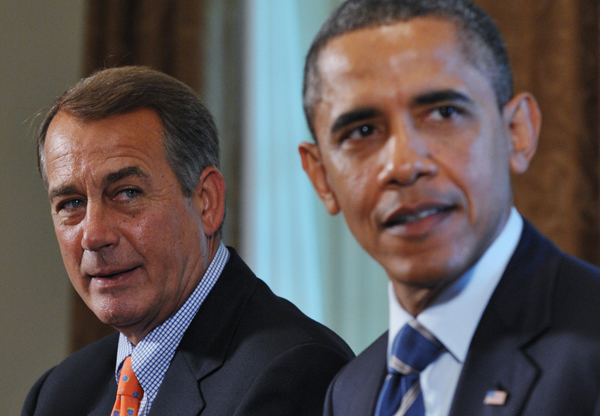
House Speaker John Boehner’s (R–OH) debt-ceiling plan sparked a conservative revolt after the Congressional Budget Office (CBO) announced that his plan would not deliver the cuts he was shooting for. So now Boehner is racing to redo his debt ceiling package.
Meanwhile, over in the Senate…zippo.
Majority Leader Harry Reid (D–NV) has introduced a rival plan, which would, according to CBO, reduce the deficit by “about $2.2 trillion” if future Congresses adhere to all of its spending caps and other policy changes. That’s a mighty big if.
This would be in exchange for increasing the debt ceiling by $2.7 trillion, which flies in the face of the widespread agreement that the nation’s borrowing should increase by only as much as Washington is willing to cut. His plan also relies extensively on gutting the military. Non-war discretionary spending cuts are puny over the next two years and don’t even reach $1 trillion 10 years out. The remainder of deficit reduction—$375 billion—comes from the interest savings arising from these projected cuts.
In exchange for this $2.2 trillion in highly dubious cuts, Reid would immediately increase the debt ceiling by $2.7 trillion. The net effect: President Obama gets an extra half-trillion dollars of the people’s credit card to play with.
Reid’s plan also calls for a joint select committee to deliver additional “deficit reduction” measures, and of course in the Senate, that would be even more likely to result in tax hikes than in the House. And Reid takes Social Security, Medicare, and Medicaid—the real cause of medium- and longer-term deficits—off the table for the transformational reforms they so desperately require. But rather than put his plan up for a vote, Reid has opted instead to stir the cauldron of D.C. vitriol to new heights of excess. Senator Chuck Schumer (D–NY) said that if Republicans “refuse this offer, it simply means they want to default.” What did Harry Reid say about Boehner’s plan?” Democrats will not vote for it. Democrats will not vote for it. Democrats will not vote for it. It’s dead on arrival in the Senate, if they get it out of the House.”
Yep, it’s hot ‘round here.
This is a sad departure from the decorum this great chamber once stood for. James Madison is said to have described this august body as “the great anchor” of government. So let’s consider Harry Reid’s senatorial leadership moments on our nation’s appalling budget and debt predicament. The Senate:
House Speaker John Boehner’s (R–OH) debt-ceiling plan sparked a conservative revolt after the Congressional Budget Office (CBO) announced that his plan would not deliver the cuts he was shooting for. So now Boehner is racing to redo his debt ceiling package.
Meanwhile, over in the Senate…zippo.
Majority Leader Harry Reid (D–NV) has introduced a rival plan, which would, according to CBO, reduce the deficit by “about $2.2 trillion” if future Congresses adhere to all of its spending caps and other policy changes. That’s a mighty big if.
This would be in exchange for increasing the debt ceiling by $2.7 trillion, which flies in the face of the widespread agreement that the nation’s borrowing should increase by only as much as Washington is willing to cut. His plan also relies extensively on gutting the military. Non-war discretionary spending cuts are puny over the next two years and don’t even reach $1 trillion 10 years out. The remainder of deficit reduction—$375 billion—comes from the interest savings arising from these projected cuts.
In exchange for this $2.2 trillion in highly dubious cuts, Reid would immediately increase the debt ceiling by $2.7 trillion. The net effect: President Obama gets an extra half-trillion dollars of the people’s credit card to play with.
Reid’s plan also calls for a joint select committee to deliver additional “deficit reduction” measures, and of course in the Senate, that would be even more likely to result in tax hikes than in the House. And Reid takes Social Security, Medicare, and Medicaid—the real cause of medium- and longer-term deficits—off the table for the transformational reforms they so desperately require. But rather than put his plan up for a vote, Reid has opted instead to stir the cauldron of D.C. vitriol to new heights of excess. Senator Chuck Schumer (D–NY) said that if Republicans “refuse this offer, it simply means they want to default.” What did Harry Reid say about Boehner’s plan?” Democrats will not vote for it. Democrats will not vote for it. Democrats will not vote for it. It’s dead on arrival in the Senate, if they get it out of the House.”
Yep, it’s hot ‘round here.
This is a sad departure from the decorum this great chamber once stood for. James Madison is said to have described this august body as “the great anchor” of government. So let’s consider Harry Reid’s senatorial leadership moments on our nation’s appalling budget and debt predicament. The Senate:
- Has not passed a budget in nearly 900 days,
- Rejected the House-passed 2012 budget by 40–57,
- Rejected the Obama budget 97–0,
- Abdicated the hard decision on the House’s first plan debt ceiling plan—Cut, Cap and Balance—and voted against letting the legislation come to the floor for a vote.
Wednesday, July 27, 2011
White House Confirms It Will Likely Sign Any Debt Deal Congress Sends

Up until today, the White House has attempted to portray President Obama as the mediator of a grand bargain, but his role has increasingly diminished as Congressional leaders have lost faith and trust in the negotiations taking place in the West Wing. It is now clear that President Obama is on the sidelines, without a plan or position, hoping Congress can solve the impasse without him.
When this statement was pointed out, Pfeiffer immediately began to walk back the statement, saying: “no, I said I believed a short term can’t pass congress not shld it”. [A note to non-Twitter users, with a 140 character limit on messages, this type of shorthand is common] But that is not the question Pfeiffer was asked.
This exchange merely confirms what observers have been noting for weeks; the President’s veto-threats and ultimatums are political theater and not much more. With the administration’s deadline fast approaching, any bill Congress sends the White House will certainly get a presidential signature.
Saturday, July 23, 2011
Bipartisan Rejection of Obamacare’s IPAB Rationing Board Grows
This week, the House Budget Committee and Energy and Commerce Committee held hearings to examine the Independent Payment Advisory Board (IPAB), a board of unelected bureaucrats tasked under Obamacare to reduce the growth in Medicare spending.
During the Budget Committee hearing, Grace-Marie Turner, president of the Galen Institute, described the board:
[T]he IPAB is unprecedented in the power given to unelected officials to direct hundreds of billions of dollars in federal spending. The IPAB will give unelected, unaccountable government appointees the power to make decisions about payment policy in Medicare that will ultimately determine whether millions of seniors have access to the care they need. This challenges the very principles of representative democracy and consent of the governed.Understandably, the board’s overreach has lawmakers on both sides of the aisle concerned. In his testimony, Senator John Cornyn (R–TX) said he was “concerned that IPAB’s enormous power will grow at the expense of Congress and the people’s elected representatives.” Representative Frank Pallone, Jr. (D–NJ), described IPAB as a sign of a “growing imperialistic presidency.” Representative Allyson Schwartz (D–PA) struck at the heart of the issue, saying, “[W]e cannot conceal fundamental flaws in our health care system by simply cutting reimbursements to hospitals and physicians.”
Therein lies the problem. Since the board is restricted in the methods it can pursue to reduce costs, its main tool will be to cut provider reimbursement rates. Payment rates that do not accurately reflect the true costs of providing health services can serve as a dramatic barrier to care, as Medicare’s chief actuary explained before the Budget Committee in the highlighted video. Deep cuts are already included in current law, and if an unelected board cuts even further, the effects will be profound.
To imagine the result isn’t difficult. As Turner said:
If the spending reductions in the law today were to take place, seniors could face long waits for appointments and treatments, and many would be forced to wait in line in over-crowded emergency rooms to get care, just as Medicaid patients do throughout the country today.Medicaid pays doctors only 58 cents for every dollar paid by private insurance, and in many parts of the country, providers actually lose money to see Medicaid patients. If cuts in current law go into effect, Medicare will pay doctors 57 percent of what private insurers pay in 2012, dropping below Medicaid. Moreover, the actuary warns that Obamacare’s cuts to hospital payments could cause 30 percent of providers of inpatient services to become unprofitable.
With reductions like these already written into law, IPAB’s effects would be disastrous. As a result, repeal efforts are already underway in the House of Representatives. But while bipartisan support builds against IPAB, some on the left would have the board go even further. Judith Feder of the Center for American Progress told the Budget Committee: “Congress should…modify IPAB’s current spending target to apply not just to Medicare but to private insurance. Indeed, to all health care spending, and extend its authorities to trigger recommendations for all payer payment reform if the target is breached.”
Medicare’s $37 trillion in unfunded promises—and runaway spending in the health care sector at large—must be addressed, but not by a government body that can do so only by restricting access to health care. Instead, lower costs and higher quality of care can be achieved by introducing competition and consumer choice through the reforms included in Heritage’s Saving the American Dream plan.
What’s Wrong with the Gang of Six Plan?
Desperate for a “balanced” approach to resolving the debt ceiling impasse, President Obama glommed on to the Gang of Six’s plan before the ink was dry.
The plan has lots of tough-talking language intended to make both sides of the aisle tingle. But that’s where the balance ends. In reality, it’s a mostly empty bipartisan shell—heavy on tax hikes and promises of spending cuts, but devoid of details on how to make the sweeping transformative changes needed to solve our debt and spending crises.
A core problem, of course, is that plan’s false assumption that we need “balance”—i.e., both tax hikes and spending cuts—to solve a spending crisis. Naturally, the only “balance” needed to solve a spending crisis is spending cuts. Tax hikes only “enable” more bad spending behavior. But set that aside for a moment. Just what are the problems with the Gang of Six’s “Promises, Promises” proposal?
First, the heavy reliance on tax hikes….. er, revenues. Yes, they claim their proposed “tax reform” delivers $1.5 trillion in real tax relief. But the “reform” also generates an additional $1 trillion in revenues for the federal coffers to meet the deficit target (plus another $133 billion for the Highway Trust Fund). But wait, there’s more! Masked in cloudy language about CBO baselines is the fact that they would let the Bush tax cuts expire—hiking taxes another $3.8 trillion. At the end of the day, the Gang’s plan would raise taxes by as much as $4.9 trillion and give $1.5 trillion back. What they trumpet as a tax cut is really a $3.4 trillion tax hike.
And not to worry, the Gang assures us, not a penny of the new tax revenue will go to new spending. It will all be used to pay down the debt. Riiight! By definition, every extra dollar of tax revenue permits an extra dollar of spending.
Yes, the plan suggests some good tax ideas, like rate reductions and corporate tax reform. But the price tag for the bad ideas is way too high and the details for the good are far too sketchy.
And what about the crux of their plan: a $3.7 trillion deficit reduction target. Will it arrive there by spending cuts? Taxes? Some combination of both? It’s anybody’s guess. The plan presents absolutely no overall spending target, either in dollars or percent of GDP. So how does it stack up to the House-passed budget, or the House-passed “Cut, Cap and Balance” bill? Nobody knows.
All they tell us is their plan would work in three phases. Phase one is what they call an “immediate aggressive deficit reduction down payment” of $500 billion. Is that spending cuts or “immediate aggressive” tax hikes? Unclear. And even if the “down payment” is all cuts, how soon is “immediate”? Will any cuts take effect this year? In 2012? Or will they all be made in the immediate, post-2012 future?
Phase Two of the plan would put various congressional committees to work getting spending reductions, budget process reforms and the tax hike details fleshed out. Again, everything happens in the future. Results could be delivered in six months, but there is no requirement or mechanism to make sure it happens. All in all, there are no guarantees of action, no requirements that any cuts actually take place.
As for the few specifics of what they might deliver, the Gang seeds their plan with ideas for both sides of the aisle:
Phase Three is the Gang’s vague goal to make Social Security solvent over 75 years – but only after Phase One passes the Senate. How you do this really matters. It’s entirely possible to develop a plan that fixes Social Security over 75 years while materially worsening deficits now. That’s not gonna fly.
And here’s where the fine print is insidious. The Gang inserted a poison pill for their entire plan: if the Social Security phase does not pass with 60 votes, then somehow the previous deficit-reduction bill is null and void. If this is the case – why offer the bill at all?
The nation faces two debt issues: the current debt ceiling and the fact that, under current policies, the national debt is set to soar much, much higher. Credit-rating agencies have announced the obvious – if the United States doesn’t get its debt under control, its credit rating is at risk. Given the scant details and the vagueness of even the goals themselves, the Gang’s plan will not meet the Moody’s test for ensuring a AAA credit rating any more than would the fundamentally flawed McConnell-Reid plan. And melding the Gang’s plan into McConnell-Reid as some suggest wouldn’t make matters any better.
At the end of the day, this empty skeleton of a plan delivers nothing but risk. Risk that spending won’t be cut now. Risk that spending won’t be cut in the future. Risk – make that a probability – that taxes will go up. Risk that our debt will go up without the transformational changes needed to put the nation on a sound economic and fiscal path.
Like its Senatorial cousin, the McConnell-Reid “cut, run, and hide” plan, the proposal offered by the Gang of Six is long on promises and short on concrete action. Washington should get to work making real cuts spending cuts. Now.
The plan has lots of tough-talking language intended to make both sides of the aisle tingle. But that’s where the balance ends. In reality, it’s a mostly empty bipartisan shell—heavy on tax hikes and promises of spending cuts, but devoid of details on how to make the sweeping transformative changes needed to solve our debt and spending crises.
A core problem, of course, is that plan’s false assumption that we need “balance”—i.e., both tax hikes and spending cuts—to solve a spending crisis. Naturally, the only “balance” needed to solve a spending crisis is spending cuts. Tax hikes only “enable” more bad spending behavior. But set that aside for a moment. Just what are the problems with the Gang of Six’s “Promises, Promises” proposal?
First, the heavy reliance on tax hikes….. er, revenues. Yes, they claim their proposed “tax reform” delivers $1.5 trillion in real tax relief. But the “reform” also generates an additional $1 trillion in revenues for the federal coffers to meet the deficit target (plus another $133 billion for the Highway Trust Fund). But wait, there’s more! Masked in cloudy language about CBO baselines is the fact that they would let the Bush tax cuts expire—hiking taxes another $3.8 trillion. At the end of the day, the Gang’s plan would raise taxes by as much as $4.9 trillion and give $1.5 trillion back. What they trumpet as a tax cut is really a $3.4 trillion tax hike.
And not to worry, the Gang assures us, not a penny of the new tax revenue will go to new spending. It will all be used to pay down the debt. Riiight! By definition, every extra dollar of tax revenue permits an extra dollar of spending.
Yes, the plan suggests some good tax ideas, like rate reductions and corporate tax reform. But the price tag for the bad ideas is way too high and the details for the good are far too sketchy.
And what about the crux of their plan: a $3.7 trillion deficit reduction target. Will it arrive there by spending cuts? Taxes? Some combination of both? It’s anybody’s guess. The plan presents absolutely no overall spending target, either in dollars or percent of GDP. So how does it stack up to the House-passed budget, or the House-passed “Cut, Cap and Balance” bill? Nobody knows.
All they tell us is their plan would work in three phases. Phase one is what they call an “immediate aggressive deficit reduction down payment” of $500 billion. Is that spending cuts or “immediate aggressive” tax hikes? Unclear. And even if the “down payment” is all cuts, how soon is “immediate”? Will any cuts take effect this year? In 2012? Or will they all be made in the immediate, post-2012 future?
Phase Two of the plan would put various congressional committees to work getting spending reductions, budget process reforms and the tax hike details fleshed out. Again, everything happens in the future. Results could be delivered in six months, but there is no requirement or mechanism to make sure it happens. All in all, there are no guarantees of action, no requirements that any cuts actually take place.
As for the few specifics of what they might deliver, the Gang seeds their plan with ideas for both sides of the aisle:
- Repealing the CLASS Act—the new entitlement to long-term care for the elderly—is a great idea. But repeal is likely to happen with or without the Gang’s plan. Everyone agrees the entitlement’s Ponzi Scheme financing is doomed to fail, making elimination the only viable option.
- Setting a savings target for Medicare and Medicaid is a small step in the right direction, and fully paying to fix the automatically scheduled cuts to doctors and other health care providers is laudable as well. But the Gang is silent on how it will achieve those savings and solve the Doc Fix. They leave that to the committee process, which has been perennially unable to do this.
- Switching the inflation index used for federal spending to “Chained CPI,” a more realistic measure of the cost of living, is sound. But details like where and when matter. If the new inflation index applies to the tax code, then it’s a tax hike on everyone.
- Reforming federal pay and launching a small program of asset sales, are good ideas, but the Gang’s goals here are underwhelming.
- Continuing their war on the successful, the Gang would make our already highly progressive tax code even more progressive.
- Rooting out fraud, waste and abuse in entitlement spending…well, who could object to that? Though one has to wonder why Congress is waiting to be told to do it.
Phase Three is the Gang’s vague goal to make Social Security solvent over 75 years – but only after Phase One passes the Senate. How you do this really matters. It’s entirely possible to develop a plan that fixes Social Security over 75 years while materially worsening deficits now. That’s not gonna fly.
And here’s where the fine print is insidious. The Gang inserted a poison pill for their entire plan: if the Social Security phase does not pass with 60 votes, then somehow the previous deficit-reduction bill is null and void. If this is the case – why offer the bill at all?
The nation faces two debt issues: the current debt ceiling and the fact that, under current policies, the national debt is set to soar much, much higher. Credit-rating agencies have announced the obvious – if the United States doesn’t get its debt under control, its credit rating is at risk. Given the scant details and the vagueness of even the goals themselves, the Gang’s plan will not meet the Moody’s test for ensuring a AAA credit rating any more than would the fundamentally flawed McConnell-Reid plan. And melding the Gang’s plan into McConnell-Reid as some suggest wouldn’t make matters any better.
At the end of the day, this empty skeleton of a plan delivers nothing but risk. Risk that spending won’t be cut now. Risk that spending won’t be cut in the future. Risk – make that a probability – that taxes will go up. Risk that our debt will go up without the transformational changes needed to put the nation on a sound economic and fiscal path.
Like its Senatorial cousin, the McConnell-Reid “cut, run, and hide” plan, the proposal offered by the Gang of Six is long on promises and short on concrete action. Washington should get to work making real cuts spending cuts. Now.
Friday, July 8, 2011
Why Do National Social Programs Frequently Fail?
In a recent issue of Time, Joe Klein acknowledges the ignored reality that national-scale programs based on effective pilot programs frequently do not yield the same successful results. His case in point is Head Start—a “Great Society” pre-school program intended to provide a boost to disadvantaged children before they enter elementary school.
Head Start was based on a few pilot programs, such as the Perry Preschool program, that were believed to be effective. Advocates asserted that a national preschool program for disadvantaged children would yield the same positive results.
However, the 2010 Head Start Impact Study, a scientifically rigorous evaluation of multiple Head Start sites throughout the nation, found that the program is clearly ineffective. The program has had little to no positive effects for children granted access to Head Start.
Klein asks, “Why do so many [government programs] succeed as pilots and fail when taken to scale?” The answer to his question is two-fold. First, national programs often do a poor job of replicating the crucial factors found in the pilot programs that are necessary for producing the same successful results, such as hiring highly skilled staff. Second, the social conditions contributing to the success of a particular pilot program are often not present in other settings. A very poignant example is the case of police departments performing mandatory arrests in domestic violence incidents.
During the 1980s, criminologists Lawrence W. Sherman and Richard A. Berk (currently professors at the University of Pennsylvania) analyzed the impact of mandatory arrests for domestic violence incidents on future domestic violence incidents in Minneapolis, Minnesota. The experiment found that mandatory arrests led to significantly lower rates of domestic violence. Police departments from across the nation adopted the mandatory arrest policy based on the results of this lone program conducted in a single city. Did the positive results hold when mandatory arrest policies were replicated and evaluated in other cities?
What worked in Minneapolis did not always work in other locations. Replications in Omaha, Nebraska; Milwaukee, Wisconsin; and Charlotte, North Carolina; found that mandatory arrests lead to long-term increases in domestic violence. Apparently, re-offenders, knowing that they would be automatically arrested and spend the night in jail, responded by becoming even more abusive to their partners.
A subsequent analysis by Sherman in his book Domestic Violence: Experiments and Dilemmas postulated that arrested individuals lacking a stake in conformity within their communities were significantly more likely to engage in domestic violence after arrest, while married and employed arrested individuals were significantly less likely to commit further domestic violence infractions. Thus, the social conditions in Omaha, Milwaukee, and Charlotte led to an entirely different result than in Minneapolis.
Policymakers and advocates of social programs often assume that a single social program found to be effective in a single setting will automatically have the same results when implemented in other settings. This assumption too frequently turns out to be dead wrong.
Head Start was based on a few pilot programs, such as the Perry Preschool program, that were believed to be effective. Advocates asserted that a national preschool program for disadvantaged children would yield the same positive results.
However, the 2010 Head Start Impact Study, a scientifically rigorous evaluation of multiple Head Start sites throughout the nation, found that the program is clearly ineffective. The program has had little to no positive effects for children granted access to Head Start.
Klein asks, “Why do so many [government programs] succeed as pilots and fail when taken to scale?” The answer to his question is two-fold. First, national programs often do a poor job of replicating the crucial factors found in the pilot programs that are necessary for producing the same successful results, such as hiring highly skilled staff. Second, the social conditions contributing to the success of a particular pilot program are often not present in other settings. A very poignant example is the case of police departments performing mandatory arrests in domestic violence incidents.
During the 1980s, criminologists Lawrence W. Sherman and Richard A. Berk (currently professors at the University of Pennsylvania) analyzed the impact of mandatory arrests for domestic violence incidents on future domestic violence incidents in Minneapolis, Minnesota. The experiment found that mandatory arrests led to significantly lower rates of domestic violence. Police departments from across the nation adopted the mandatory arrest policy based on the results of this lone program conducted in a single city. Did the positive results hold when mandatory arrest policies were replicated and evaluated in other cities?
What worked in Minneapolis did not always work in other locations. Replications in Omaha, Nebraska; Milwaukee, Wisconsin; and Charlotte, North Carolina; found that mandatory arrests lead to long-term increases in domestic violence. Apparently, re-offenders, knowing that they would be automatically arrested and spend the night in jail, responded by becoming even more abusive to their partners.
A subsequent analysis by Sherman in his book Domestic Violence: Experiments and Dilemmas postulated that arrested individuals lacking a stake in conformity within their communities were significantly more likely to engage in domestic violence after arrest, while married and employed arrested individuals were significantly less likely to commit further domestic violence infractions. Thus, the social conditions in Omaha, Milwaukee, and Charlotte led to an entirely different result than in Minneapolis.
Policymakers and advocates of social programs often assume that a single social program found to be effective in a single setting will automatically have the same results when implemented in other settings. This assumption too frequently turns out to be dead wrong.
Sunday, June 26, 2011
How Much Do We Owe? That’s the $62 Trillion Question

Earlier this month USA Today splashed a headline on its front page that declared: “U.S. owes $62 trillion.” I wrote a couple blog posts about it — one on the alarming size of the number and another on its juxtaposition with the Anthony Weiner story.
It turns out this number — a staggering debt of $534,000 per household — has caused quite the controversy. James Agresti, president of Just Facts, wrote to me about an editorial from Bloomberg taking USA Today to task for making a miscalculation. That came as a shocker to me. USA Today wasn’t the first to project a number that size. And my colleague Bill Beach and I used that very data point during a presentation last week in Raleigh, NC.
Were we wrong?Bloomberg’s editorial board thinks it’s absurd for USA Today to draw the conclusion:
Trillions have now joined billions as amounts that are part of everyday conversation, but impossible to make meaningful. News that you thought your country owed $14.3 trillion but it actually owe $62 trillion has less impact than pulling a $20 out of your wallet and discovering that it’s only a $10. The notion that you yourself personally owe half a million dollars is simply unreal — it can’t be processed.
I’d agree the number is hard to process. In fact, I was just asking for better ways to explain the size of one trillion.
But as for the number itself, Agresti, whose nonprofit institute is dedicated to researching and publishing verifiable facts on public policy issues, isn’t buying Bloomberg’s argument. He rebuts three main points for American Thinker:
The first “obvious flaw” in such calculations, the Bloomberg editors tell us, is that “if a government retiree is entitled to a pension of, say, $35,000 a year, that is both a cost to the government and a benefit to that retiree. But only the cost is taken into account.”
Not true. The entire cost of the pension is not taken into account, only the gap between the employee’s pension contributions (money or service) and what the federal government has promised the employee in return. Big difference.
Assume for the sake of argument that Bloomberg offers its employees defined-benefit pensions (like the federal government), and imagine that Bloomberg told its editorial board that they would each have to cough up an extra $481,000 in pension contributions above and beyond their current commitments in order to receive the same pensions they were originally promised. Are we to believe that the editors would slough it off by saying, “It’s not a problem because the money will be used to pay for our benefits”?
Second, the Bloomberg editors claim that such calculations do not account for the fact that a dollar owed in the future is less of a burden than a dollar owed today.
Wrong again. Our calculations and those of USA Today and the Peter G. Peterson Foundation use net present values that account for the time value of money. To quote the U.S Treasury report from which we obtained most of the data used in our calculations, “The [social insurance] estimates are actuarial present values … Present values recognize that a dollar paid or collected in the future is worth less than a dollar today, because a dollar today could be invested and earn interest. To calculate a present value, future amounts are thus reduced using an assumed interest rate….”
It bears noting that the figures used by Just Facts are “closed group present values,” which are calculated in a manner that approximates how publicly traded companies are required to calculate their debts and obligations. In other words, we are using accounting principles that the federal government demands from publicly held corporations.
Third, the Bloomberg editorialists tell us that such calculations are plagued by “false precision” because they “require peering decades into the future.”
Forgive the obvious point, but private pension funds and insurance companies have been performing such calculations for many decades with generally acceptable results. Moreover, are we supposed to ignore the government’s liabilities and unfunded obligations because we cannot specify them with absolute precision? Imagine a corporate executive trying to make that argument to the SEC.
Thursday, June 23, 2011
VIDEO: Rep. Fred Upton Blames EPA for Obstructing Alaska Oil Drilling
Shell spent five years and more than $3.5 billion while waiting for the Environmental Protection Agency to grant a permit for drilling in Alaska. Now lawmakers in Congress hope to force the hand of EPA bureaucrats by mandating a six-month deadline to review permit applications.
The Jobs and Energy Permitting Act is set for a House vote Thursday and is expected to easily pass with bipartisan support. The White House declined to issue a veto threat Tuesday. There is a companion bill in the Senate, but its fate is uncertain. (UPDATE: The House approved the measure Wednesday night by a margin of 253 to 166 with the support of 23 Democrats.)
House Energy and Commerce Chairman Fred Upton (R-MI) visited Heritage yesterday and sat down to talk about the high price of gasoline and why more energy production is the answer. We spoke to him about this week’s vote and what it means for consumers.Upton also announced that his committee would move next to the North American-Made Energy Security Act, which would expedite a final decision on the Keystone XL pipeline. The project is designed to carry oil from Canada to refineries in the Gulf of Mexico. An Energy and Commerce subcommittee approved the legislation by voice vote last week.
Speaking at yesterday’s Bloggers Briefing, Upton stressed the benefits of the pipeline expansion. The development of Canadian oil sands would create an estimated 100,000 U.S. jobs and reinforce our relationship with Canada, this country’s No. 1 source of imported oil.
The pipeline is a monumental undertaking both in terms of its construction and impact on energy markets. Canada believes it would be able to produce at least 3 million barrels a day by the end of the decade. At least 1 million barrels would make their way to U.S. markets.Judging from recent public-opinion surveys, Americans overwhelmingly support increased production domestically and through strengthened ties with Canada. A Quinnipiac Poll this spring found 67 percent want offshore drilling to resume. And a poll commissioned by the Canadian Association of Petroleum Producers and the American Petroleum Institute put the figure at 85 percent of Americans who believe U.S. government policies should support the use of Canadian oil.
Wednesday, June 22, 2011
How the Debt and Economy Are Reshaping Millennials’ Life Choices
America’s sluggish economy and mounting debt threaten to change the very fabric of our country as young people delay major life changes. New polling released by the upstart Generation Opportunity reveals the dramatic consequences facing America as the Millennials grow older.
A staggering 77 percent of Americans age 18–29 say they have already delayed or will delay a major life change or purchase due to economic factors, according to a survey commissioned by Generation Opportunity with the polling company, Inc./WomanTrend. It has a margin of error of plus or minus 4 percent.
Millennials — whom my colleague Bill Beach and I call the Debt-Paying Generation — will have enormous impact on the country. John Della Volpe, director of polling at Harvard’s Institute of Politics, projects that Millennials will make up 38 percent of the electorate by 2020.
The decisions they make today should raise alarm with all Americans. According to the Generation Opportunity poll results:- 44 percent will delay buying a home;
- 28 percent will delay saving for retirement;
- 27 percent will delay paying off student loans or other debt;
- 27 percent will delay going back to school/getting more education or training;
- 26 percent will delay changing jobs/cities;
- 23 percent will delay starting a family; and
- 18 percent will delay getting married.
One factor causing concern among Millenials stems from their deep dissatisfaction toward their current employment. According to the poll, just 52 percent are satisfied with their current jobs.
It’s led to overall angst with the current leadership in Washington — including President Obama, who captured two-thirds of the youth vote in the 2008 presidential election. That appeal is beginning to fade: For example, just 31 percent approve of Obama’s handling of unemployment.
There’s a silver lining for conservatives, however. The survey showed that 76 percent would like to see federal spending reduced, and 69 percent want the federal government to make sacrifices right away.
Subscribe to:
Posts (Atom)